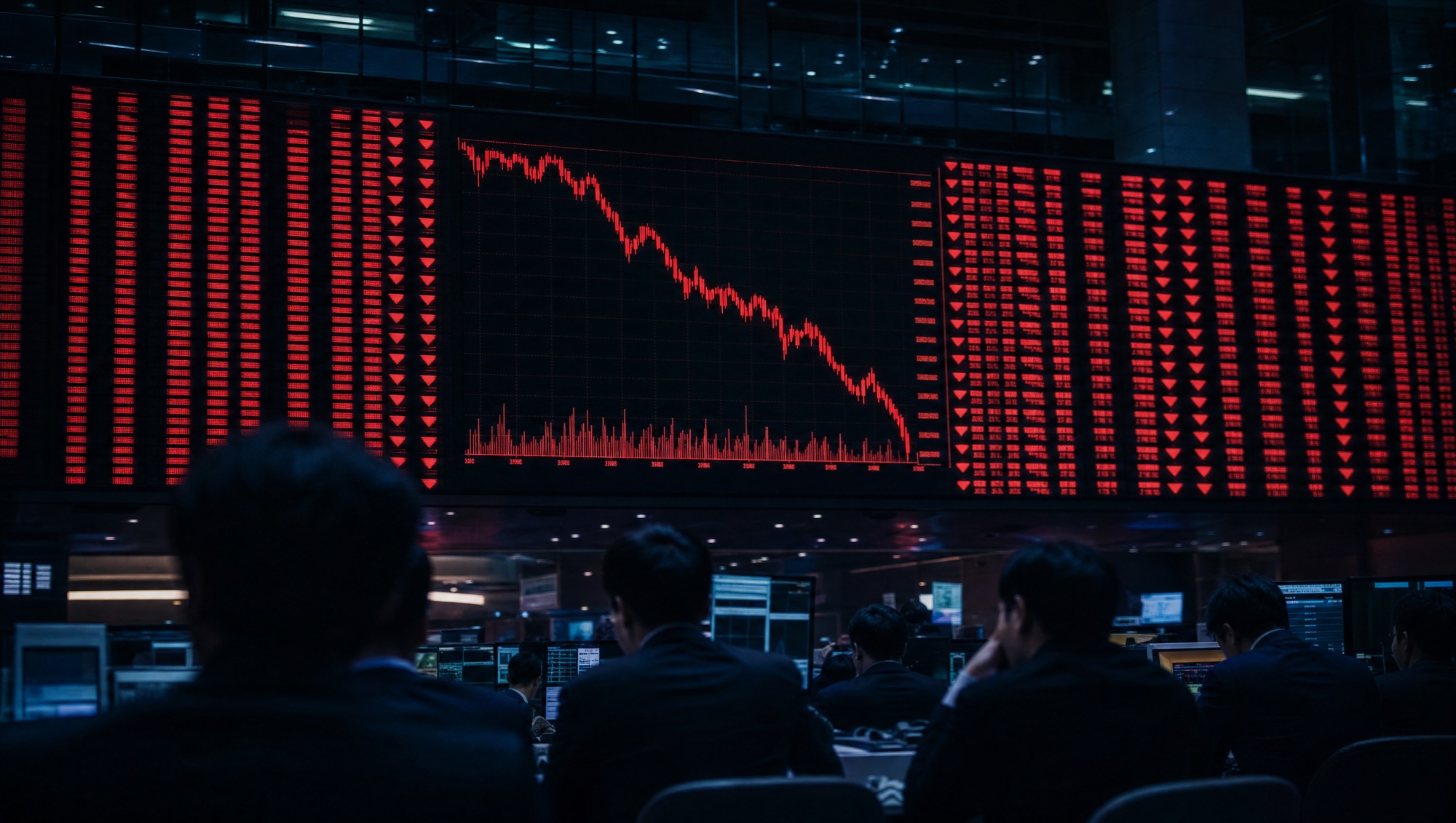
On June 19th, the KOSPI closed at 9,385.59. All-time high. The index had more than doubled in under six months, up 116% on the year, making Korea comfortably the best-performing major stock market on the planet. Six weeks later, on August 3rd, it was trading around 6,297.
That is roughly a third of an entire national stock market, gone. Not one sector. Not one blown-up hedge fund. The index.
What makes this worth a proper breakdown isn't the size of the drop. Markets drop. What makes it worth studying is that the people who lost the most money were the ones who had been right. They called the biggest equity rally in the world, they were early, and they still ended up worse off than if they had never traded it at all. Not because they picked the wrong stocks. Because of how they were positioned.
If you trade a funded account, this is the clearest real-world argument for drawdown rules you are going to see this year. Here's what happened, how the mechanism worked, and what to actually do with it.
The Timeline: Up 116%, Then a Third Gone
The rally had a real story behind it. Global demand for AI memory chips went vertical, and Korea makes the memory. SK Hynix reported Q2 revenue of ₩79.32 trillion, up 257% year over year, at a 76% operating margin. Korean exports in July were up 62.9% year over year, with semiconductor shipments up 179%. This was not a meme. The earnings showed up.
Retail piled in. Korean households put roughly ₩78 trillion (about $54.2 billion) into KOSPI shares across May and June alone, encouraged by a government market-reform push and a wave of newly launched single-stock leveraged ETFs. Samsung Electronics was up over 400% since the start of 2025. SK Hynix was up close to 1,000%.
Then it turned. July was the worst month for the KOSPI since the global financial crisis, closing down 22% at 6,595.45. Trading was halted by circuit breakers four separate times during the month. Across two sessions, roughly ₩864.5 trillion (around $608 billion) of market value evaporated. On one day, the index fell nearly 11%. On another, it rallied 18% intraday, its biggest ever gain, and retail still sold a record amount of stock into it.
By August 3rd, the index was down another 4.5% on the day and sitting roughly 33% below the June peak. Samsung finished July down 21%. SK Hynix down 35%.
Now hold that thought, because the index numbers are the gentle version of this story.
Two Stocks Are the Whole Index
Samsung Electronics and SK Hynix together account for more than half of the KOSPI's total market capitalisation. More than half. That means the "diversified Korean equity index" is functionally a two-name semiconductor bet with 200 other companies attached for decoration.
This matters more than it sounds. A trader who bought the index thought they were spreading risk. What they actually owned was a concentrated position in one industry, exposed to one demand cycle, on one side of one global trade. When the AI memory narrative wobbled, there was nothing else in the index to absorb it.
It is the same trap as running six "different" forex positions that are all short dollar. You feel diversified. You are not. You have one trade in six accounts, and when it goes against you it goes against all of it at once. Correlation is the risk that hides inside a position sheet that looks balanced.
The Leverage Stack: How ₩38 Trillion Became a Forced Seller
Here is where it stops being a market story and becomes a risk-management story.
Korean retail didn't just buy the rally. They borrowed to buy it, and then bought leveraged products with the borrowed money. Two layers of gearing on the same trade.
Layer one: margin debt. Margin loan balances on the domestic market hit a record ₩38.63 trillion (about $26.1 billion) on June 24th, five days after the peak. Total investor borrowing, including broader credit, had already passed ₩60 trillion (roughly $40.5 billion) by the end of May. The correlation between margin balances and the KOSPI 200 has been measured at 92%, which is a polite way of saying the market was going up because people were borrowing, and people were borrowing because the market was going up.
Layer two: single-stock leveraged ETFs. These are funds that give you roughly 2x the daily move of a single company. Assets in Korean leveraged ETFs went from under $10 billion in January to over $50 billion in June. By late July they were worth about $16 billion.
The damage in those products was brutal. The KODEX SK Hynix single-stock leverage ETF fell more than 80% from its June 23rd peak. The Samsung equivalent fell close to 75% from its June 3rd high. Citi put total retail losses on leveraged ETFs at around ₩56.3 trillion, roughly $38.7 billion.
If you don't trade leveraged ETFs, the number that should stop you is the mechanism, not the loss. A 2x daily-reset product does not give you 2x the move over a month. It gives you 2x the daily move, compounded, and in a volatile market that compounding works against you even if the underlying eventually recovers. SK Hynix fell 35% in July. Its 2x ETF fell over 80%. That gap is not a bug. That is the product working exactly as designed.
Then the feedback loop. Goldman Sachs estimated that by July 13th, more than 1.2 million leveraged retail accounts had received margin calls, and between 320,000 and 360,000 had already been liquidated. Total forced liquidations reached ₩2.3 trillion in about two and a half months.
Forced selling is different from ordinary selling. It doesn't care about price, valuation, or your view. A margin call sells your position at whatever the market will pay, which pushes the price down, which triggers the next margin call. Once that loop starts, the fundamentals stop mattering for a while. That is why the index fell 33% while the underlying companies were posting record profits.
A Margin Call Is a Drawdown Rule You Don't Get to Set
This is the part that should land for anyone trading firm capital.
Every trader who got liquidated in Seoul in July had a risk limit. They just didn't choose it, didn't know where it was, and only found out when their broker hit the button. That is what a margin call is: a hard drawdown rule, set by someone else, enforced without warning, at the worst possible moment.
A prop firm drawdown rule is the same thing with the humane parts left in. You know the number before you place the trade. It is written down. It is the same on your best day and your worst day. And critically, it triggers early — usually somewhere between 5% and 10% — instead of at the point where your equity has already been mathematically destroyed.
Run the numbers side by side. Say you had $10,000 in the Korean AI trade at the June peak:
- Unleveraged index exposure: down roughly 33% to about $6,700. Painful, recoverable, you still own the position.
- Margin-financed at 2:1: a 33% index move is a 66% equity move. You are down to around $3,400, assuming you weren't stopped out first — and most were.
- 2x single-stock leveraged ETF on SK Hynix: down over 80% to under $2,000, from an underlying that fell 35%.
- Same $10,000 in a funded account with a 10% max drawdown: the account closes at $9,000. You lose the evaluation fee. Your capital is intact.
Traders complain about drawdown limits constantly, and the complaint is understandable: the rule exists partly because the firm is protecting its own capital, not out of concern for your feelings. But the effect is identical to what a professional risk desk does to a bank trader, and it is the single reason a bad month is a bad month instead of a career-ending event. If you want the full mechanics of how gearing changes the maths on a position, we broke it down in What Is Leverage?
The uncomfortable version of this: the Korean retail trader who blew up in July was not stupid, undisciplined, or badly informed. They were right about AI memory demand, right about Korean export strength, and right about the earnings. Being right is not protection. Position sizing is protection.
It Didn't Stay in Seoul
If you trade indices, tech, or FX, this is already on your charts whether you follow Korea or not.
The Philadelphia Semiconductor Index fell as much as 6% in a single session during the worst of it, its longest losing streak of the year. The Nasdaq 100 dropped 9.7% from its record high, just short of a formal correction. Global chip stocks shed more than $1 trillion in market value. Micron and Seagate fell more than 8%, Western Digital nearly 7%, Sandisk 14%, AMD 8%, Intel 6%. Asian tech and the US AI trade are now effectively the same position quoted in two currencies.
On the macro side, the picture is genuinely strange. The Bank of Korea raised its base rate 25bp to 2.75% on July 16th, its first hike since January 2023. The won, which you would expect to collapse alongside the equity market, instead had its strongest month since March 2009, trading around 1,430 per dollar after reported dollar-selling intervention by the authorities and a $30.32 billion July trade surplus. Strong exports, hawkish central bank, collapsing stock market, all at once.
And the policy response is still live. Finance Minister Koo Yun-cheol convened an emergency meeting with Korea's top financial authorities on July 29th after the two-day wipeout. New single-stock leveraged ETF listings were halted mid-July. Officials have publicly floated activating the national market-stabilisation fund, tightening daily price limits, and reimposing a short-selling ban — a measure Korea only lifted last year after significant international pushback.
For a trader, that last item is the practical risk. Rule changes announced overnight can gap a market before you have any chance to react. If you are holding correlated exposure through this, size for the gap, not for the chart.
Five Things Worth Taking From This
1. Check what your positions actually are, not what they're called. The KOSPI is an index that behaves like two stocks. Look at your open trades and ask what single event would move all of them the same direction at once. If you can name it in one sentence, you have one position, not five.
2. Leverage is a timing bet, not a size bet. Gearing doesn't just multiply your return, it shortens how long you can be wrong before you're removed from the trade. SK Hynix holders who were down 35% still owned the stock. The 2x ETF holders who were down 80% mostly did not.
3. Know your liquidation point before you enter. Not roughly. Exactly. On a funded account you already have this — a daily loss limit and a max drawdown, in writing. Most retail traders who blew up in July could not have told you their number on June 18th.
4. Volatility regimes change faster than strategies do. The KOSPI went from a steady grind higher to four circuit breakers in a month, including an 11% down day and an 18% up day. If your position sizing was calibrated to June's volatility, it was dangerously wrong by mid-July. When average daily range doubles, halve your size. That is not caution, it's just keeping your risk per trade constant.
5. Being early and being wrong feel identical in your P&L. The AI memory story may well be intact. Earnings certainly suggest it is. That is no comfort at all if you were liquidated at the July lows. Survive first, then be right.
Wrapping Up
Korea just ran the largest live experiment in retail leverage we have seen in years, in public, with real money. The result: over a million margin calls, roughly $38.7 billion of losses in leveraged ETFs alone, a national index a third off its high, and a finance ministry holding emergency meetings about products it approved months earlier.
The lesson underneath it isn't "avoid Korea" or "AI is over." It's that the trade you are in matters less than the size you are in it at, and that a risk limit you set yourself in advance is infinitely better than one a broker sets for you at the bottom.
Every funded trader already has that limit. It is the rule most people find the most annoying part of trading firm capital. July in Seoul is a fairly expensive reminder of what it's actually for. If you want to build the habits around it properly, the risk management track in the Pipster Academy is the place to start.
Sources
Korea Exchange KOSPI index data, Trading Economics (KOSPI and USD/KRW, August 3 2026), Bloomberg, CNBC, Fortune, Korea JoongAng Daily, Seoul Economic Daily, Citi leveraged ETF loss estimates, Goldman Sachs margin call estimates, Bank of Korea July 16 rate decision, Korea Ministry of Economy and Finance statements, SK Hynix Q2 2026 results, Korea Customs Service July trade data.