You're scrolling through your prop firm's trading conditions and you see it: "swap fee: -$3.42." You vaguely remember the word "swap" from a finance article or a YouTube video about Wall Street derivatives. You assume it's the same thing. It's not. And that misunderstanding quietly eats into your profits every single night you hold a position.
The word "swap" is one of the most confusing overlaps in trading terminology. In traditional finance, it refers to a multi-trillion-dollar derivatives market where institutions exchange cash flows. In prop trading and retail forex, it refers to the small overnight fee your broker charges or pays you for holding a trade past the daily rollover time. Same word, completely different mechanics, completely different impact on your account. In this post, you'll learn what each version of "swap" actually means, why the prop trading version is the one that matters for your funded account, and how to stop it from silently draining your balance.
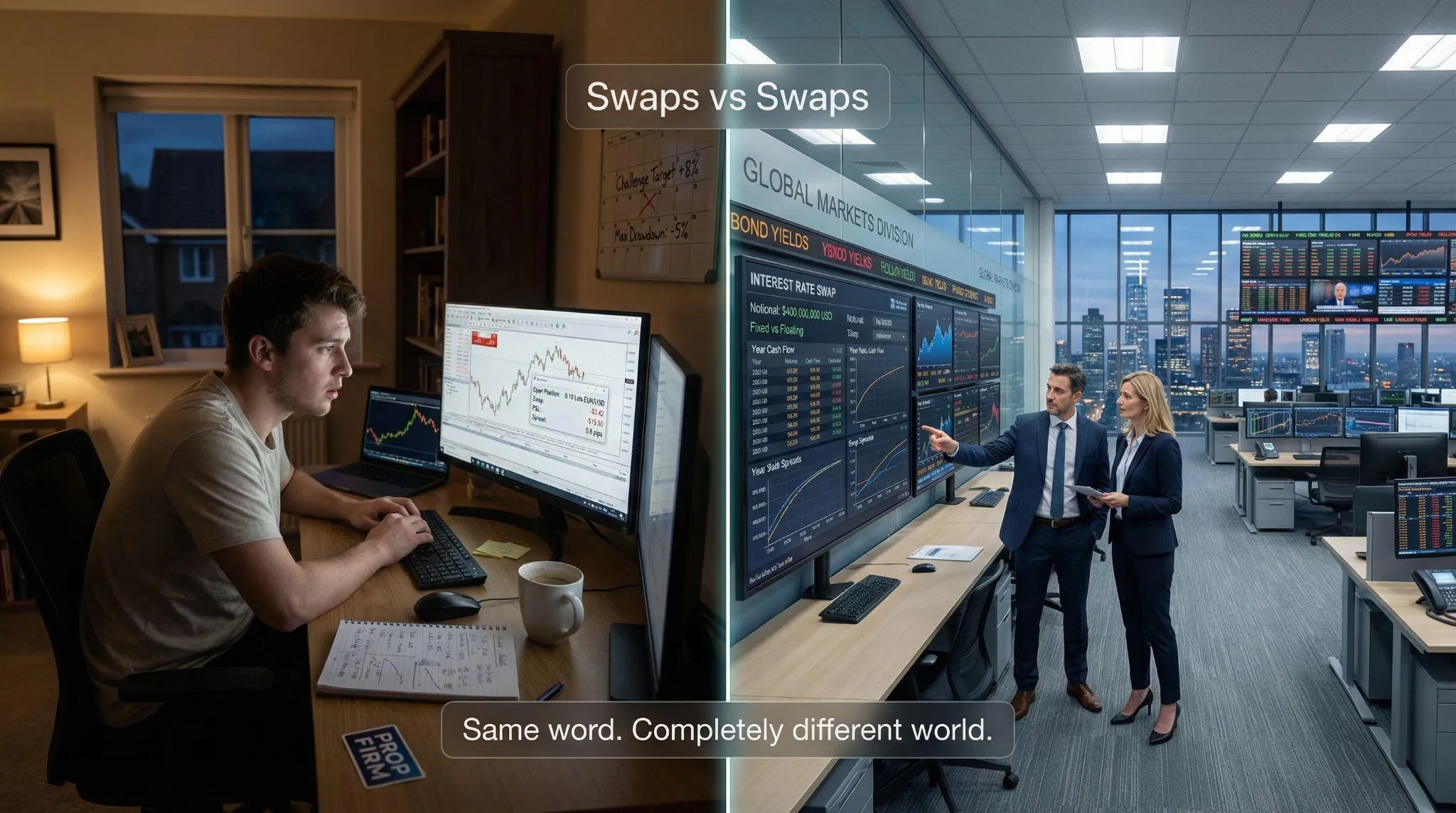
Swaps in Traditional Finance: The Wall Street Version
In the institutional world, a swap is a derivatives contract where two parties agree to exchange, or "swap," cash flows over a set period. Think of it like a structured trade between two banks or hedge funds, where each side is betting on different outcomes.
The most common type is an interest rate swap. Here's how it works: Bank A is paying a variable interest rate on a $100 million loan and they're worried rates will rise. Bank B is paying a fixed rate and thinks rates will drop. So they agree to swap their payment obligations. Bank A now pays fixed, Bank B pays variable. Neither party actually exchanges the $100 million. They just trade the interest payments back and forth. The $100 million is the notional amount, a reference number used to calculate payments, not actual money changing hands.
Other flavors include currency swaps, credit default swaps (which are essentially insurance against a borrower defaulting and became infamous during the 2008 financial crisis), and commodity swaps that lock in a price for oil, gas, or agricultural products.
The numbers in this market are staggering. The global interest rate swap market alone has a notional value north of $400 trillion. These are instruments designed for massive institutions managing billions in risk. If you're trading a $100K funded account, this version of swaps has essentially zero direct impact on your trading. But it's useful to understand, because when someone in a finance conversation says "swap," this is what they mean. It's not what's showing up on your MetaTrader terminal.

Swaps in Prop Trading: The Overnight Fee That Actually Hits Your P&L
Now here's the version that matters to you. In retail forex and CFD trading, which is where most prop firm challenges happen, a swap (also called a rollover fee or overnight financing charge) is the cost or credit applied to your account when you hold a position past the daily cutoff time, usually 5:00 PM New York time or 10:00 PM GMT.
Why does this exist? Because when you trade forex, you're technically borrowing one currency to buy another. If you go long EUR/USD, you're borrowing US dollars to buy euros. Each currency has an interest rate set by its central bank. The swap is the difference between those two rates, adjusted for your position size and applied daily.
Here's a concrete example. Say you're long 1 standard lot of EUR/USD. The European Central Bank's rate is 3.65% and the Federal Reserve's rate is 4.50%. You're holding euros with a lower rate and you've borrowed dollars with a higher rate. Since you're borrowing the more expensive currency, you pay the difference. That's a negative swap, and it's debited from your account every night you hold the trade.
On a typical broker, that might look like -$3.00 to -$8.00 per night for a standard lot of EUR/USD. That doesn't sound like much. But hold that trade for two weeks and you've paid $42 to $112 in swap fees alone, before commissions, before spreads, and regardless of whether the trade is winning or losing.
The flip side exists too. If you go long on a pair where you're holding the higher-yielding currency, you receive a positive swap, which is a small credit to your account each night. Some traders build entire strategies around this, called carry trades, deliberately holding positions in high-yield pairs to collect swap income.
Why Swap Fees Matter More Than You Think in a Prop Firm Challenge
Most traders ignore swap fees. They focus on entries, exits, pips gained, pips lost. And for day traders who close everything before the rollover, that's fine. You'll never pay a swap if you never hold overnight.
But if you're a swing trader holding positions for days or weeks, swap fees compound in ways that can genuinely affect your challenge outcome.
Say you're trading a $100K funded account with an 8% profit target, so you need to make $8,000. You're swing trading EUR/USD, holding an average position of 2 lots for an average of 5 days per trade. At a swap cost of roughly -$6 per lot per night, each trade costs you $60 in swaps. If you take 10 swing trades over the course of your challenge, that's $600 in swap fees, or 7.5% of your profit target, gone before you even account for spreads and commissions.
Now factor in triple swap Wednesday. Most brokers charge three days' worth of swap on Wednesday night to account for the weekend settlement cycle. That Wednesday hold doesn't cost you $12. It costs you $36 for a 2-lot position.
On a funded account where every dollar counts toward your profit target and against your drawdown limit, $600 in hidden fees is the difference between passing and failing for some traders. It's not dramatic. It's a slow leak.
How to Manage Swap Fees on a Funded Account
You don't need to avoid swaps entirely, you just need to know they exist and factor them into your planning. Here's how:
Check your firm's swap rates before you trade. Every broker and prop firm publishes swap rates, usually in the platform's contract specifications. On MetaTrader, right-click any pair in Market Watch, select "Specification," and scroll to "Swap Long" and "Swap Short." Know these numbers before you place a trade, not after.
Factor swaps into your risk-reward calculation. If your target on a swing trade is 150 pips ($300 on a mini lot) and you plan to hold for 7 days, check if the swap cost ($4-$7/night x 7 = $28-$49) significantly eats into your reward. If swaps consume more than 10-15% of your target profit, consider whether the hold time is worth it.
Lean toward positive-swap direction when the setup allows. If you're looking at AUD/JPY and the technical setup is borderline for both long and short, and long carries a positive swap while short carries a negative one, that's a legitimate tiebreaker. Don't force trades based on swap direction, but when the setup is neutral, let the swap tip the decision.
Be aware of swap-free accounts. Some prop firms offer Islamic or swap-free accounts that don't charge overnight fees. Instead, they may charge an administration fee or widen the spread. If you're a swing trader and swap costs are eating into your results, it's worth investigating whether your firm offers a swap-free option and what the trade-offs look like.
Avoid holding over Wednesday without a reason. That triple-swap charge on Wednesday night means holding a losing position from Wednesday into Thursday costs you three nights' fees for one night of time. If you're on the fence about closing a trade midweek, the triple swap should be part of that calculation.
Common Mistakes Traders Make With Swaps
Confusing the two types and overcomplicating things. Some traders read about interest rate swaps and credit default swaps and assume they need to understand derivatives theory to trade forex. You don't. The swap on your platform is just an overnight fee. It's not a complex financial instrument.
Ignoring swap fees entirely. The opposite mistake. "It's only a few bucks a night" adds up fast over a 30-day challenge. Track your cumulative swap costs in your trading journal alongside commissions and spreads. You might be surprised how much you're paying.
Holding losing trades longer because of positive swap. This is a trap. If you're long AUD/JPY collecting $5/night in positive swap, but the trade is down 80 pips ($800 on a standard lot), the $5/night isn't saving you. Positive swap should never be a reason to avoid cutting a losing trade. Your risk management rules always override swap considerations.
Not checking swap rates before entering swing trades. Rates change. Central banks adjust interest rates, and your broker adjusts swap rates accordingly. The swap you paid last month on GBP/USD might be different this month. Always verify current rates, especially after a major central bank meeting.
Quick Reference
| What you need to know | Details |
|---|---|
| What's a swap on my prop firm platform? | An overnight fee charged/paid for holding past 5 PM ET |
| When is it charged? | Every night at rollover; triple on Wednesdays |
| Can I avoid it? | Yes. Close positions before rollover, or use a swap-free account |
| Typical cost | $1+ per standard lot per night, varies by pair and broker |
| Does it affect my drawdown? | Yes. Negative swaps reduce your equity just like any other cost |
| Can it be positive? | Yes. Holding certain pairs in the right direction earns you a small credit |
Conclusion
"Swap" means two different things depending on who you're talking to. In traditional finance, it's a massive derivatives contract between institutions. On your prop firm platform, it's a small nightly fee that reflects the interest rate difference between the currencies you're trading. The Wall Street version is interesting dinner conversation. The prop trading version is the one that actually affects your P&L, your drawdown, and your ability to pass a challenge.
Know your swap rates. Factor them into swing trades. Don't let a few dollars a night turn into hundreds over the course of a challenge.
Disclaimer
This content is provided by the Pipster Market Analysis Team for educational and informational purposes only. It is not investment advice and does not constitute a recommendation, offer, or solicitation to buy or sell any financial instrument. All trading and investing involves risk, including potential loss of capital. Past performance is not indicative of future results.