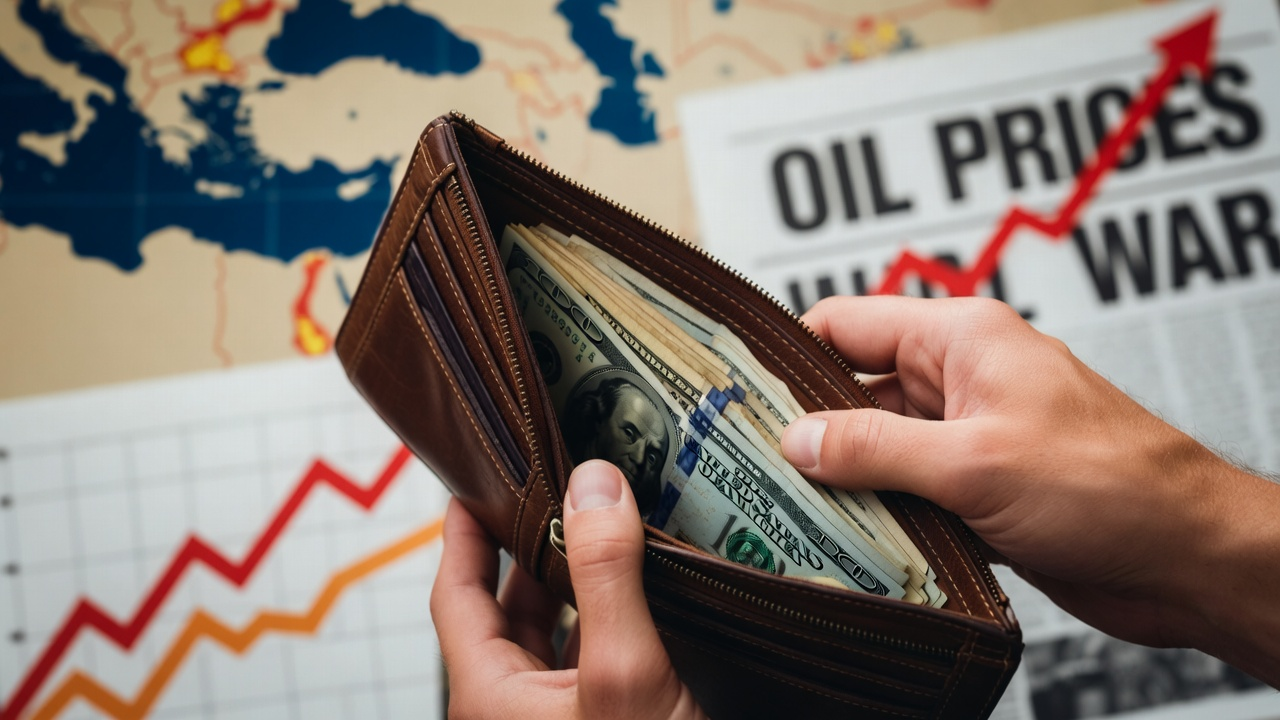
Two weeks ago, crude oil was sitting around $70 a barrel. Today it's near $90. Last weekend it blew past $110. Then Trump made some comments about Iran and the whole thing cratered back toward $80 in a single session. If you trade oil on a funded account, you probably aged five years watching that candle print. If you're just a normal person trying to book a summer holiday, your flights are about to get more expensive. Possibly a lot more expensive.
The US-Israeli strikes on Iran that kicked off on February 28th didn't just create a geopolitical crisis. They broke the oil market. Jet fuel is up 80% in a month. United's CEO is publicly warning that airfares are going up "quickly." Gas at the pump jumped 16% in a single week. And we're only two weeks into this.
So what's actually going on, and how bad does it get? Let's walk through it.
The Strait of Hormuz Is the Whole Story
Forget the headline price for a second. The reason oil is moving like this comes down to one narrow strip of water between Iran and Oman called the Strait of Hormuz. About 20% of the world's oil supply passes through it every day. Normally, around 24 crude tankers make the transit daily.
On March 1st, that number dropped to four. Three of those four were Iranian-flagged. Roughly 200 internationally trading tankers are currently stuck in the Persian Gulf with no way out.
That's not a supply disruption. That's a blockade. And when a fifth of global oil supply can't physically leave the region it's produced in, prices go vertical.
Here's what makes this especially weird for anyone watching the charts: the fundamentals before the war were actually bearish. Global inventories were building. J.P. Morgan had Brent averaging $60 for 2026. There's no underlying shortage of oil. There's a shortage of the ability to move it. So the spot price has completely detached from the forward curve. Contracts for 2027 and 2028 delivery are still hanging around the high $60s. The market is basically saying: "Right now is insane, but we don't think this lasts."
Traders call this structure backwardation, where the spot price sits way above futures prices. It's the kind of setup that creates massive volatility and, for people who understand it, massive opportunity.
How a Naval Standoff in the Gulf Ends Up on Your Boarding Pass
There's a pretty direct chain reaction between what's happening in the Strait of Hormuz and the price of your flight to Miami this summer. It goes like this.
Crude oil rises. Brent went from roughly $70 to $90 in under two weeks, spiking above $110 along the way.
Jet fuel follows, and it follows harder. Jet fuel is refined from crude, so it tracks the price closely, but it has its own supply constraints on top. Spot jet fuel went from about $2.25 per gallon a month ago to nearly $4.00 per gallon last Friday. That's an 80% increase, worse than crude itself, because refining capacity was already stretched thin before any of this started.
Airlines eat the cost. For a while. Fuel makes up 20-30% of what it costs to operate an airline. And here's the kicker: none of the major US carriers hedge their fuel costs right now. Not Delta, not United, not American, not Southwest. They're all fully exposed. At current prices, the four biggest carriers are looking at an extra $5.8 billion in fuel costs through year-end.
Airlines pass it on to you. A Skift analysis estimates the industry needs ticket prices to go up at least 11% to cover the additional $24 billion in fuel costs. United CEO Scott Kirby said on Sunday that the impact on fares will "probably start quick." Some carriers are already tacking fuel surcharges onto international routes.
In real terms: a domestic round trip that was $350 last month could be $390 or more by April. An international fare of $1,200 might push past $1,330. Not catastrophic on any single ticket, but it adds up across the economy, hitting business travel, tourism, and consumer spending all at once.
It's Not Just Flights
Airlines get the headlines because they literally cannot function without jet fuel. There's no alternative. But the same price shock is running through everything.
Gas hit $3.45 per gallon nationally on Sunday, up 16% from the week before. That's real money out of every commuter's pocket and every delivery driver's margin. If your grocery bill has crept up over the last two weeks, this is a big part of why. Moving food from farms to warehouses to stores just got dramatically more expensive.
The inflation picture is shifting too. Markets had been pricing in rate cuts from the Fed later this year. An oil shock like this threatens to push inflation back up right when it was finally cooling down, which could force the Fed to hold rates higher for longer or at least delay cuts. That ripples into mortgage rates, credit card rates, auto loans, everything.
Stock markets took the hit. The Dow dropped over 1,000 points in futures trading during the initial spike. Airline stocks are down double digits across the board since the strikes began. Energy stocks and defense contractors, obviously, are having a great month.
What This Means If You're Trading Oil on a Funded Account
If you trade oil, nat gas, or anything correlated on a funded account, you're staring at the most volatile energy market in years. That can make you a lot of money or it can blow your challenge in an afternoon. Depends entirely on how you handle it.
The opportunity is obvious. Crude has been moving $5 to $10+ per day. For context, WTI's average daily range in January was under $2. A single standard lot of crude oil CFD moves about $10 per penny of price movement, so a $5 intraday swing is worth $5,000 per lot. On a funded account, you don't need big size to pull real money out of this environment.
The risk is equally obvious. Last Monday, oil went from $110 to below $80 in post-settlement trading after a single presidential comment. One sentence from one person wiped out $30 per barrel. If you were long at $105 with a wide stop, that wasn't a losing trade. That was potentially your entire drawdown evaporating in minutes. And slippage during moves like that can be brutal. Your stop at $100 might fill at $94.
So how do you trade it without blowing up?
Cut your size. Seriously. If you normally trade 1 lot of oil, go to 0.5 or 0.25. The range is doing the heavy lifting. A $5 move on a quarter lot is still $1,250. That's a great day on a funded account, and you haven't put your drawdown at risk to get it.
Respect the gap risk. Oil futures trade nearly around the clock, but there are gaps at session opens and after major headlines. During an active military conflict, those headlines come at 2am. If you hold overnight, accept that you might wake up to a $3-$5 gap against you and size for that possibility.
Watch the news, not just the chart. This is not a technical market right now. It's a news-driven market. A Reuters headline saying tanker traffic is resuming could dump oil $10 in an hour. A report that Iran hit a tanker could spike it $15. No RSI divergence or moving average is going to warn you before that happens. You need to be watching the geopolitical feed alongside your charts.
Think about trading the second-order effects. If oil itself feels too violent (and honestly, it is), look at the instruments that move on the same catalyst but with less insane ranges. Airline stocks drop when oil rises. The dollar tends to strengthen during geopolitical crises. Gold is doing its classic safe-haven thing. These are calmer ways to express the same view.
Check your firm's news trading rules. Some prop firms restrict trading during high-impact news events. The Iran situation is generating market-moving headlines multiple times a day. If your firm has rules about this, make sure you know where you stand before you trade, not after. Getting disqualified on a technicality after hitting your profit target would be a painful way to learn.
Is $90 Oil Here to Stay?
Nobody knows. Full stop. Anyone who tells you they're certain is either lying or trying to sell you a newsletter.
The bull case is straightforward. If the Strait stays disrupted for weeks or months, 20% of global supply remains offline and prices grind toward $130, maybe $150. Kpler's lead crude analyst has floated $150 by end of March if tanker traffic doesn't resume.
The bear case is that this resolves faster than the market expects. Forward contracts for 2027 and 2028 are still in the high $60s, which tells you the market's long-term view hasn't actually changed. A ceasefire, a diplomatic deal, or even just a partial reopening of the Strait could snap prices back to $70 in days. G7 countries could release strategic petroleum reserves to bridge the gap. And again, the pre-war fundamentals were soft. The oil exists. It's just temporarily stuck.
For traders, the only honest answer is: trade what's in front of you, not what you think is coming. Right now that means elevated vol, news-driven moves, and wider ranges than anything you've seen in years. Size down. Stay disciplined. Don't try to call the top or bottom of a move that's being driven by military decisions made in rooms you'll never be in.
Wrapping Up
The Iran conflict is doing what oil shocks always do. Costs cascade outward. Airlines feel it first because they can't run planes on anything else, and fares are going up 11% or more. But it doesn't stop there. Gas prices, grocery bills, inflation expectations, Fed policy, stock markets. Everything downstream of oil is getting repriced right now.
For funded traders, this is the most interesting oil market in years. The ranges are huge. The catalysts are clear. But the risk is proportional. The traders who come out of this well are the ones trading small, staying informed, and treating every headline like it could move the market $5 in either direction. Because it can.
And if you're booking a flight this summer, maybe don't wait on it.
Sources
EIA crude oil spot prices, Kpler tanker tracking data, Skift airline industry analysis, J.P. Morgan 2026 Brent forecast, United Airlines CEO statements, AAA national gas price averages, NYMEX WTI and Brent futures data.