
Prop firms paid a total of almost $325 million to traders in 2025, according to Prop Firm Match, and that figure excluded major players like FTMO and The5ers. A decade ago, the idea that retail traders could access six-figure accounts without depositing a cent of their own capital would have seemed absurd.
To understand how we got here, you have to go back to the model that came before: the B-Book retail broker. The prop trading industry didn't appear out of thin air. It evolved from the economics of traditional retail brokerage, and in many ways, it improved on them.
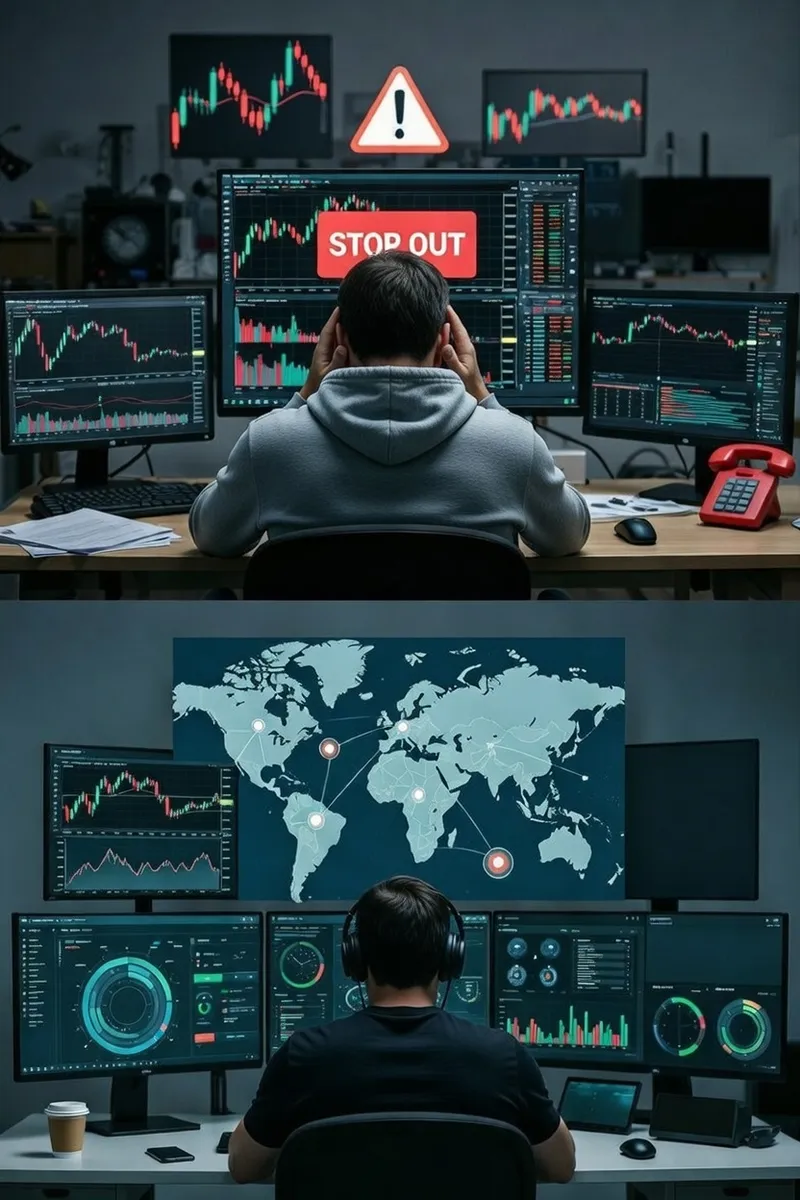
Where It Started: The B-Book Model
The B-Book model has been the backbone of retail forex and CFD brokerage for decades. When a trader opens a position with a B-Book broker, the trade stays in-house. The broker takes the opposite side. If the trader loses (and ESMA data confirms that 74-89% of retail CFD accounts do), the broker keeps the difference.
By some industry estimates, up to 95% of all FX/CFD brokers operate some version of this model. The economics work because most retail traders are unprofitable. The FCA consistently reports around 80% of accounts in the red, with average losses ranging from £1,600 to £29,000 per client.

Under MiFID II (introduced in 2018), European brokers were forced to disclose these loss rates on their websites. The intention was transparency. The effect was a spotlight on a model where the broker's interests and the trader's interests were structurally misaligned: the broker profits most when the client loses.
This was the world retail traders operated in for years. It worked for brokers. It was less clear who else it worked for.
The Shift: What Prop Firms Changed
The funded trader model emerged as something genuinely different for the retail trader, even though the underlying economics share DNA with B-Book.
Here's what changed:
Risk was capped and transparent. In the B-Book world, a trader deposits $5,000 or $10,000 and can lose it all. The drawdown is whatever the market and their leverage allow. With a prop firm challenge, the maximum loss is the challenge fee itself, typically $50 to $3,000. A trader knows their worst-case scenario before they start. That's a meaningful improvement in consumer protection, even without a formal regulatory requirement.
Capital became accessible on merit. Traditional retail trading was, by definition, a wealth-based activity. You traded the capital you had. Prop firms flipped this into a skill-based model. A trader in Lagos, Karachi, or Manila can access a $200,000 account for the cost of a challenge fee, provided they can demonstrate the ability to trade within risk parameters. This is a genuine democratisation of market access that simply didn't exist before.
Failure became cheaper. A trader who blows a $10,000 deposit at a retail broker has lost $10,000. A trader who fails a $100,000 prop firm challenge has lost $500. The psychological and financial impact of learning through failure is fundamentally different. The prop model lets traders iterate, learn, and improve without catastrophic personal loss.
Accountability was built into the structure. B-Book brokers had no particular interest in whether traders developed discipline. In fact, undisciplined traders who overtrade and take excessive risk were often the most profitable clients. Prop firms, by contrast, enforce drawdown limits, consistency rules, and risk parameters. The evaluation process, whatever its imperfections, rewards the traits that actually make a good trader: discipline, patience, and risk management.
The Numbers Tell a Story
The scale of what prop firms have created is worth appreciating.
FundedNext alone paid out almost $108 million to traders in 2025. FundingPips distributed $97 million. FTMO, which reported approximately $323.2 million in revenue in 2024, has paid out over $450 million to traders since its founding in 2015 by two students in Prague. The company now employs over 300 people.
Global interest in prop firms has grown by over 600% in four years. The industry is estimated to be worth over $5 billion, with over 2,000 firms operating worldwide. This growth isn't happening in a vacuum. It reflects genuine demand from retail traders who see a better deal than what traditional brokerage offered them.
The expansion into emerging markets has been particularly significant. South Asia, Latin America, and Africa have seen rapid adoption, with traders in these regions gaining access to institutional-scale capital for the first time. Prop Firm Match data shows South Asia as one of the most lucrative markets, with firms breaking even in as little as one month and peak return on ad spend touching 12x.
The Honest Parallels
It would be dishonest to pretend there are no similarities between the B-Book model and prop firm economics. There are.
In both models, the business benefits when traders are unprofitable. A B-Book broker profits directly from client losses. A prop firm collects challenge fees from the roughly 90% of traders who don't pass evaluations. The revenue mechanics share common ground.
The most common prop firm model today uses simulated accounts throughout, meaning no real trades are placed in the market. Profits paid to successful funded traders come from the pool of challenge fees collected from all participants.
But similarities in economics don't mean the models are equivalent for the trader. There are several key differences that make the prop firm model a step forward.
First, the conflict of interest is structurally different. A B-Book broker actively benefits from a client's ongoing losses on deposited capital. A prop firm collects its fee upfront. Once a trader is funded, the firm has an incentive to keep them funded (continued engagement, repeat challenges on new accounts, scaling fees). The incentives aren't perfectly aligned, but they're less adversarial than B-Book.
Second, the risk profile is completely different for the participant. The maximum loss is known and capped. No margin calls. No negative balance risk. No leverage-amplified losses wiping out savings.
Third, the evaluation process adds a layer of consumer protection that B-Book brokers never provided. A trader who can't manage risk within defined parameters simply doesn't get funded. The challenge acts as a filter, and while it's far from perfect, it's more protection than "here's 500:1 leverage on your life savings."
How the Industry Is Maturing
The prop trading sector went through a difficult period in 2024 & 2025, with over 80 firms shutting down. This was painful, but it was also a natural and arguably healthy maturation phase. The firms that survived were generally better capitalised, more transparent, and more operationally sound.
Several developments signal that the industry is moving in the right direction.
Broker-prop convergence. FTMO's acquisition of OANDA is perhaps the most significant structural development in the sector's history. It signals a future where prop firms and regulated brokers merge, combining the accessibility of the challenge model with the regulatory infrastructure of traditional brokerage. Other established brokers, including IC Markets (with ICFunded), Axi (with Axi Select), and Hantec, have launched their own prop offerings, bringing regulated-entity oversight to the funded trader model.
Platform maturation. The MetaQuotes restrictions that forced prop firms off MT4/MT5 pushed the sector toward diversified technology. Match-Trader, cTrader, and proprietary platforms have emerged as serious alternatives, with Match-Trader's US-trader compatibility opening the American market to firms that previously couldn't serve it.
Regulatory engagement. Rather than resisting regulation, the stronger firms are actively preparing for it. Expected changes for 2026 include mandatory licensing in key jurisdictions, stricter KYC/AML requirements, and formal profit split transparency. Dubai's Securities and Commodities Authority is developing a specific framework. The Czech Republic is tightening oversight through the Czech National Bank. This regulatory attention, far from being a threat, is the clearest sign yet that prop trading has become a legitimate, permanent part of the financial services landscape.
Better terms for traders. Competition has driven real improvements. Activation fees are disappearing. End-of-day drawdown calculations are replacing punitive trailing drawdowns. Profit splits have climbed from 70/30 to 80/20 and even 90/10 at many firms. Payout frequencies have increased. Account scaling programmes are becoming standard, with top firms offering paths from $100,000 to $4,000,000 in funded capital.
What Comes Next
The prop trading industry is no longer in its startup phase. It's entering its institutional phase.
The firms that will define the next chapter are the ones bridging the gap between the accessibility that made prop trading popular and the regulatory rigour and risk management that will make it sustainable.
For retail traders, the trajectory is clearly positive. Ten years ago, the options were: trade your own small account with a B-Book broker that profited from your losses, or don't trade at all. Today, a skilled trader anywhere in the world can access hundreds of thousands of dollars in capital, with their downside limited to a challenge fee, backed by firms that are increasingly regulated and transparent.
The B-Book model still exists, and it still works for brokers. But the funded trader model has given retail participants something the old world never offered: a path to professional-scale trading based on skill rather than capital, with manageable risk and increasingly aligned incentives.
That's not a minor evolution. That's a fundamental shift in who gets to participate in financial markets, and on what terms.
Sources
Prop Firm Match 2025 payout data, Finance Magnates industry reporting, ESMA MiFID II disclosure requirements, FCA retail trader loss statistics, FTMO public financials and OANDA acquisition details.